EduInsight: AI-Powered Feedback Analysis for Quality Education
A web-based AI-powered system called EduInsight was created to automatically analyse student feedback in order to assess the quality of instruction. To produce insightful results, the system combines quantitative ratings with AI methods like sentiment analysis, text summarization, and key-phrase extraction. For educators and administrators, it offers interactive dashboards and PDF reports.
EduInsight supports SDG-4: Quality Education and enhances efficiency, objectivity, and transparency in teaching evaluation compared to conventional feedback methods.
Keywords: Teaching Evaluation, Automated Feedback Analysis, Language Models, Sentiment Analysis, Educational Quality, SDG-4
Introduction
Student feedback is essential for improving teaching quality and learning outcomes, but traditional systems are slow, manual, and often biased.
Numerical ratings alone do not address real challenges in the classroom, and qualitative feedback is difficult to analyze by hand.
EduInsight is a web-based system that uses AI to automatically process ratings and textual feedback through a smart workflow: Admin creates programs → students enroll → teachers are assigned with AI-based performance alerts.
Through Sentiment Analysis, Text Summarization, and Key-Phrase Extraction, the system assesses student feedback to produce a KPI Rating, Sentiment Position (%), and Pedagogical Power Index (PPI) for objective insights supporting SDG 4 (Quality Education).
Literature Review
- ●Traditional teaching evaluation relies on student feedback, peer review, and administrative observation, but often lacks objectivity.
- ●Recent research highlights the use of AI, Machine Learning, and NLP to analyze student feedback more accurately.
- ●AI-based approaches allow for sentiment analysis, topic modeling, and visualization of open-ended feedback.
- ●Researchers have shown that automated feedback analysis improves teacher reflection and decision-making.
- ●This work builds on prior studies by proposing a lightweight, web-based AI system focused on actionable insights for educators.
Proposed Methodology
The proposed system uses an integrated, AI-driven approach to analyze student feedback for teaching evaluation. Students provide scores and written feedback through a secure web platform with reliable data storage and management.
AI Analysis Module
Sentiment analysis assesses overall sentiment, text summarization simplifies detailed responses, and key-phrase extraction highlights main themes.
Statistical Measures
Average scores, rating distributions, and performance trends are analyzed over time for comprehensive evaluation.
Interactive Dashboards
Results presented through bar, line, pie, and range charts for clear insights to teachers and administrators.
Automated Reports
PDF reports generated automatically for offline review, documentation, and administrative decision-making.
Mathematical Foundations
The system uses advanced mathematical models to quantify both qualitative and quantitative feedback:
Mean Rating
μ = (1/N) Σ Rᵢ
Sentiment Index
σₚₒₛ = (P / T) × 100
Pedagogical Power
PPI = (μ × 10) + (σₚₒₛ × 0.5)
Engagement Value
SEV = (V_R / E_S) × 100
Result Analysis
Overall Performance Evaluation
The EduInsight system was assessed based on real student feedback gathered during a live academic training program, involving 6 students, 1 professor, and 1 Head of Department (HOD). The system effectively handled both quantitative ratings and qualitative text feedback.
Student Rating
4.17
out of 5
HOD Rating
4.0
out of 5
Self-Assessment
5.0
out of 5
Overall Score
4.25
consolidated
The results indicate consistent and positive evaluation from all stakeholders, demonstrating the system's ability to provide objective and reliable assessment of teaching quality.
Report Generation
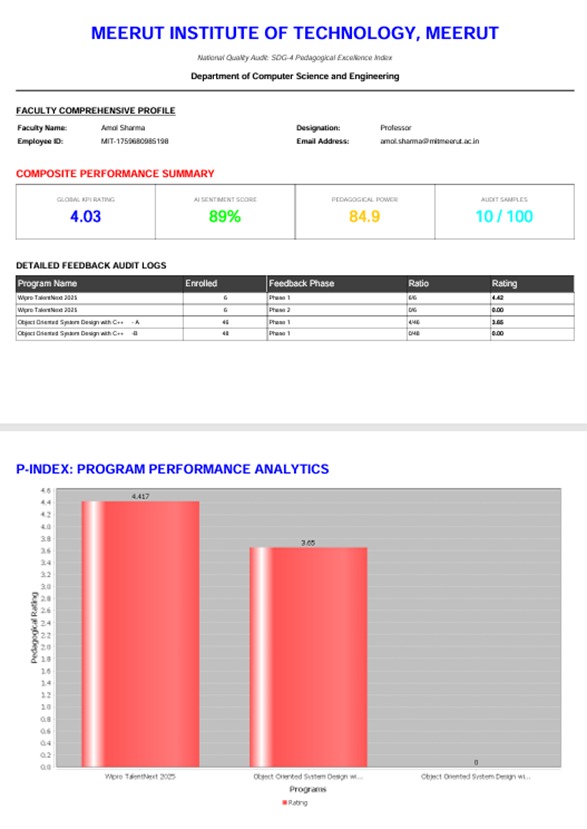
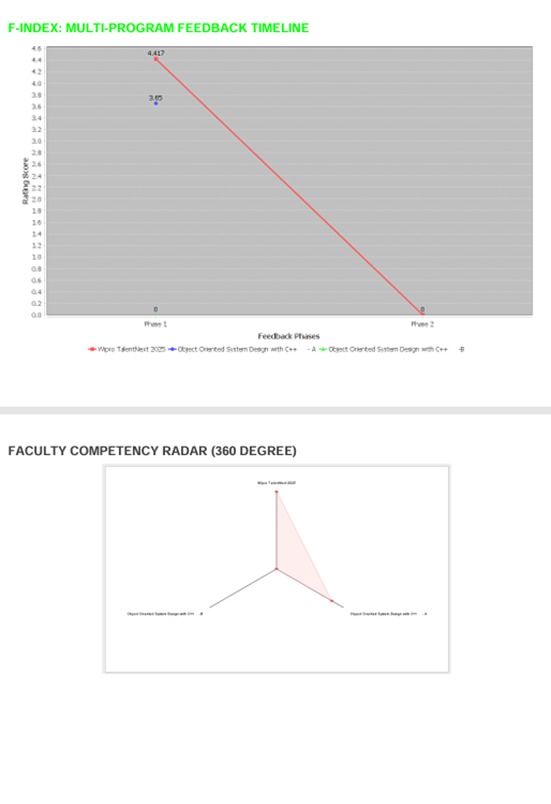
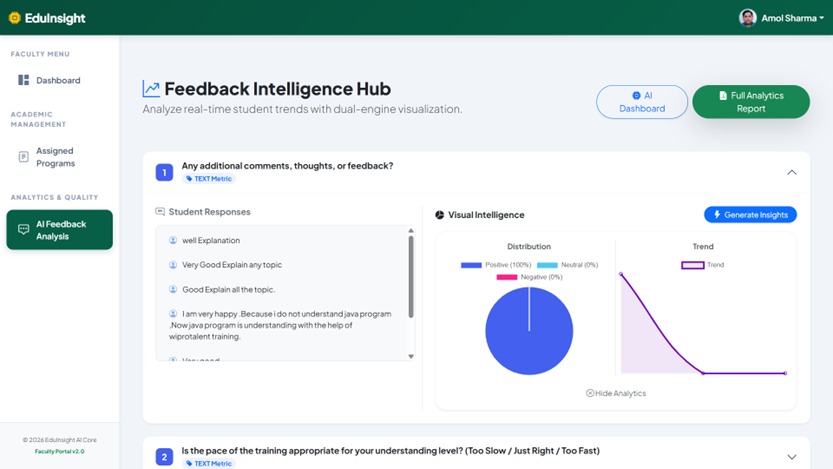
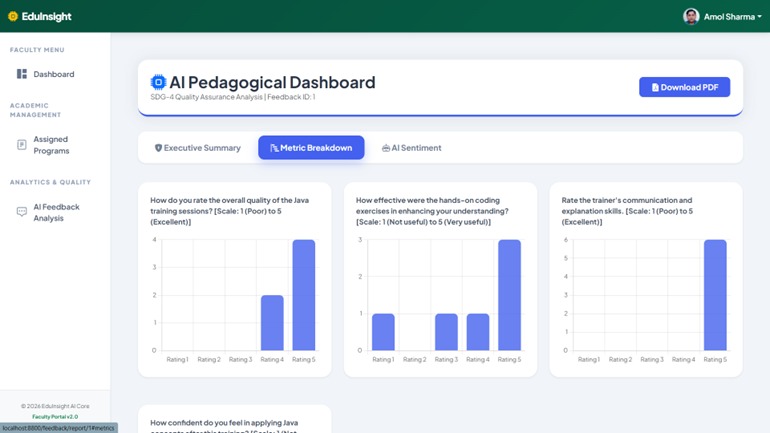
The EduInsight system generates comprehensive reports through an AI-powered Data Filtering Engine and Feedback Intelligence Hub. The system processes multi-dimensional analytics to provide actionable insights for educational quality improvement.
Qualitative Feedback Analysis
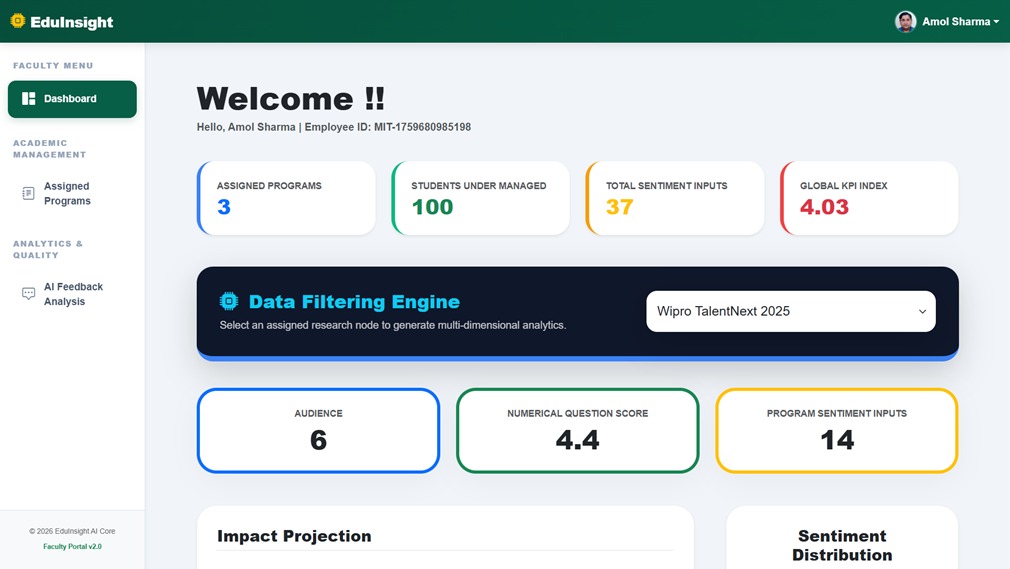
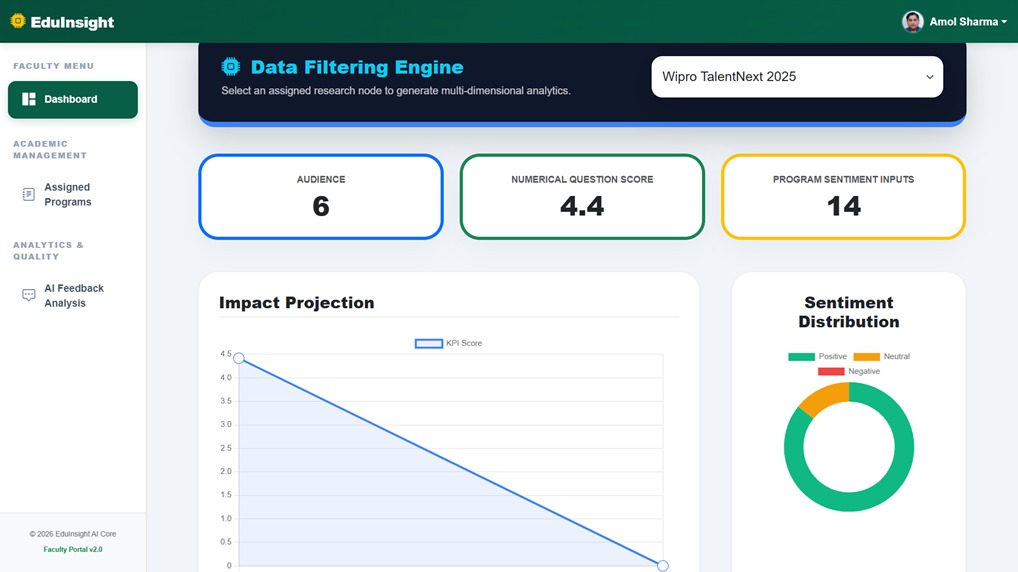
Sentiment analysis categorizes feedback into positive, neutral, and negative segments. Text summarization identifies main strengths and improvement areas. Key-phrase extraction reveals common themes in student responses. This analysis provides insights that numerical ratings alone cannot capture.
Quantitative Feedback Analysis
Bar charts display average scores for each feedback dimension. Line graphs illustrate rating trends and performance patterns over time. Interactive dashboards enable real-time monitoring of instructor performance and program effectiveness across all metrics.
Conclusion
- ●EduInsight combines numerical ratings and AI-driven qualitative analysis to provide complete teaching performance assessment.
- ●Automated sentiment analysis, text summarization, and key-phrase extraction reduce manual work, bias, and subjectivity.
- ●Interactive dashboards and downloadable PDF reports provide clear, practical, and data-driven insights to educators.
- ●The system delivers better accuracy, objectivity, and efficiency compared to traditional feedback systems.
- ●EduInsight supports faculty development, improves learning outcomes, and aligns with SDG 4 (Quality Education).
Future Works
- ●Integrate Explainable Artificial Intelligence (XAI) to interpret sentiment analysis decisions clearly and improve transparency in evaluation.
- ●Expand support for multimodal feedback analysis using text, voice, and facial expression data.
- ●Conduct large-scale longitudinal studies to assess the long-term effects on teaching quality and student learning outcomes.
- ●Develop adaptive AI models for personalized improvement and professional development plans for instructors.
- ●Deploy system across institutions with integration to academic performance indicators for broader educational impact.
References
- [1] Husain, N., & Khan, M. (2021). Students' feedback: An effective tool in teachers' evaluation system. PubMed. DOI: 10.4103/2229-516X.186969
- [2] Aragón, O., Centra, J., Gelber, D., Joye, K., & Wilson, R. (2023). Beyond the Numbers: How Directors and Chairs Interpret Student Feedback to Equitably Evaluate Teaching. Journal of Academic Ethics. Springer. DOI: 10.1007/s10805-025-09611-5
- [3] Petron, M., Blackwell, W., & Strunc, A. (2025). Dismantling inequities in the faculty evaluation system. School Leadership Review, 20(1), Article 7. Available at: https://scholarworks.sfasu.edu/slr/vol20/iss1/7
- [4] Feng Lin, Chenchen Li, Rebekah Wei Ying Lim, Yew Haur Lee (2025). Empower instructors with actionable insights: Mine and visualize student written feedback for instructors' reflection. Computers and Education: Artificial Intelligence. DOI: 10.1016/j.caeai.2025.100389
- [5] Bauer, E., Sailer, M., Niklas, F., Greiff, S., et al. (2025). AI-based adaptive feedback in simulations for teacher education: An experimental replication in the field. Journal of Computer Assisted Learning. Wiley. DOI: 10.1111/jcal.13123
- [6] Almubarak, A., Alhalabi, W., Albidewi, I., & Alharbi, E. (2024). An analytical approach for an AI-based teacher performance evaluation system in Saudi Arabia's schools. Discover Applied Sciences, Springer. DOI: 10.1007/s42452-024-06117-4
- [7] Almubarak, A., Alhalabi, W., Albidewi, I., & Alharbi, E. (2025). An AI-powered framework for assessing teacher performance in classroom interactions: a deep learning approach. Frontiers in Artificial Intelligence. DOI: 10.3389/frai.2025.1553051
- [8] Makwana, V. (2025). A comparative analysis of AI-powered and teacher-led feedback: Investigating student perceptions and writing performance. Journal of English Language Teaching. Available at: https://journals.eltai.in/jelt/article/view/JELT670102
- [9] Raihan Primasta Putra & Pujiriyanto P. (2025). The need analysis for AI-based applications to support teacher performance. Journal of Innovation in Educational and Cultural Research. DOI: 10.46843/jiecr.v6i1.2100
- [10] United Nations. (n.d.). Ensure inclusive and equitable quality education and promote lifelong learning opportunities for all. Available at: https://sdgs.un.org/goals/goal4